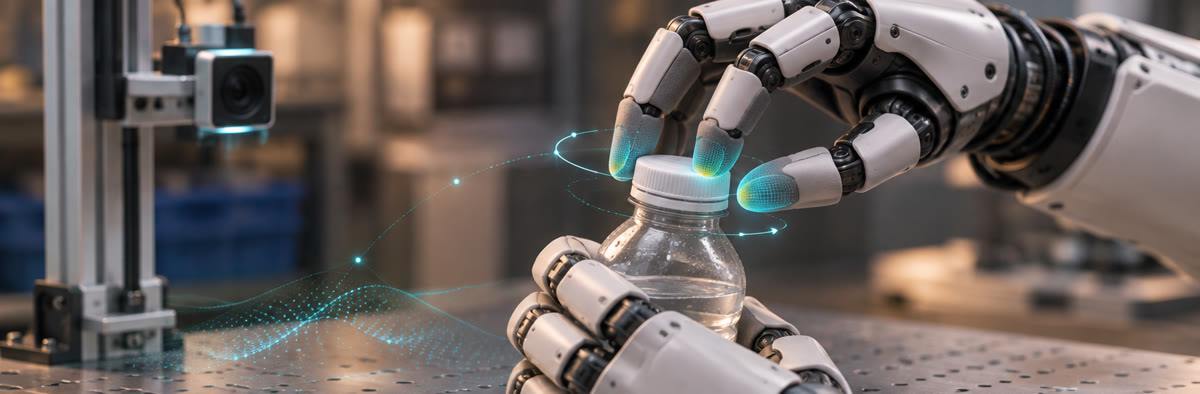
Robots are increasingly capable of recognizing objects, following instructions and planning actions. Yet some of the most demanding manipulation problems begin where visual perception becomes insufficient: at the moment of physical contact.
A robot may locate a bottle cap and position its fingers correctly, but can it detect a slipping grip? Can it sense increasing resistance before damaging a fragile object? Can it recognize the subtle contact changes involved in inserting a connector?
These questions sit at the intersection of robotics research and real-world training-data collection. The release of LingBot-Touch, a tactile foundation model from Ant Group’s Robbyant, makes the data problem especially clear: how can heterogeneous touch signals be turned into reusable information for robot learning?
Why vision alone is not enough
RGB video, depth sensing, language instructions and robot actions already provide valuable supervision for learning physical tasks. But cameras can struggle to identify a small change in grip pressure, distinguish secure contact from slip, or observe forces hidden beneath a fingertip.
Opening a cap, manipulating a flexible pouch and inserting small components may look straightforward in video. Successful execution also depends on contact location, local deformation and resistance. Tactile sensors can add information that vision does not directly measure.
What the LingBot-Touch research reports
Robbyant’s technical report, posted on 9 November 2026, describes a shared tactile representation learned from three sensor families: piezoresistive, magnetic and visuotactile. Rather than treating their raw outputs as interchangeable, the model uses sensor-specific interfaces and a shared Haptic Transformer to learn reusable latent representations.
Figures above are published by the research team; they are not independently audited commercial dataset metrics.
| Sensor modality | Reported training hours | What it can represent |
|---|---|---|
| Piezoresistive | 2,197 | Pressure-related resistance changes |
| Magnetic | 1,136 | Contact deformation through magnetic changes |
| Visuotactile | 1,650 | Contact-surface deformation observed optically |
The researchers also evaluate the model across 26 real-robot tasks on two dexterous-hand platforms, alongside simulated tasks. They report improvements when learned tactile features are added to several action-policy families. These are developer-reported experimental results, not independent proof of performance across all sensors, robots or production environments.
One important implication is that more sensors do not automatically produce better manipulation. Models must learn representations that preserve contact information while remaining usable across different sensor layouts and hardware.
Five requirements for useful tactile training data
1. Sensor identity and measurement semantics
A dataset should describe exactly which sensor produced each signal, its sampling frequency, channel layout, and the physical interpretation of its output. Raw tactile images, estimated pressure maps and calibrated forces are different deliverables. A grayscale touch image alone does not establish a reliable measurement in newtons.
2. Verified timing across modalities
Manipulation unfolds as a sequence of contact, load, movement, slip and release. Learning from synchronized visual and tactile streams requires explicit timing rules. A common exported timestamp does not, by itself, prove that camera exposure and fingertip sampling occurred at the same instant.
Depending on the task, buyers may need evidence for shared-clock or hardware-trigger mechanisms, plus measured offset, jitter, drift, any interpolation, and the definition of accepted temporal error.
3. Calibration and coordinate consistency
Visual observations, hand keypoints, IMU motion and tactile channels often use different coordinate frames. Training-ready delivery may therefore require camera intrinsics/extrinsics, hand or fingertip geometry, sensor-axis definitions and calibration records. Whether submillimeter accuracy is needed depends on the task; it should never be implied merely from the presence of a sensor.
4. Task diversity and genuine contact events
Hours recorded are not the same as hours accepted. A long video may contain idle periods, obscured interactions, repeated movements or little meaningful touch. For tactile learning, event coverage and task diversity can matter as much as nominal duration. Dataset design should specify objects, materials, tool use, grasp types, contact events and rejection rules in advance.
5. Provenance, consent and commercial data rights
Real-world data collection involves people, premises and sometimes proprietary operations. Technical usability is not enough. Commercial training rights, participant and venue permissions, provenance, privacy controls, permitted cross-border delivery and contractual rework obligations need to be documented before capture.
What robotics buyers should specify before commissioning a dataset
A useful procurement brief is more precise than “we need tactile data.” It answers the following:
- Modalities: Is the requirement monocular RGB, synchronized stereo, depth, 2D/3D hand tracking, tactile sensing or a defined combination?
- Sensor output: Are raw arrays sufficient, or are calibrated physical measurements required?
- Synchronization: What actual timing tolerance and measurement evidence must be supplied?
- Delivery: Are raw files, timestamps, calibration, session manifests, QA reports and a specific training schema required?
- Acceptance: How are buyer-accepted hours calculated, and who carries the cost of rejected or re-captured segments?
- Rights: Can the buyer use the recordings for commercial model training, including the agreed onward licenses and cross-border transfers?
Why APAC field collection may matter
Food preparation, packaging, light manufacturing, warehousing, equipment handling and hospitality workflows create varied physical interactions that can be difficult to reproduce in a laboratory. Asia-Pacific field networks may help robotics teams source task-specific observations in those environments.
But access to a workplace is only one part of the job. A usable project still requires qualified staff, compatible equipment, appropriate consent, consistent protocols, metadata, site-specific QA and clearly assigned commercial rights.
Microtaka’s approach is to coordinate buyer-defined Physical AI collection requirements with qualified APAC field operators. We assess visual, motion and tactile configurations project by project, and separate claimed hardware capability from verified export, alignment and acceptance evidence. No unvalidated sensor specification should become a buyer-facing guarantee.
The takeaway: sensor recordings are not yet training-ready data
LingBot-Touch illustrates a promising direction: shared touch representations that can draw information from multiple sensing technologies. It does not imply that every robotics project needs tactile data, or that a new sensor automatically creates a valuable dataset.
The stronger opportunity lies in collecting usable, interpretable and rights-cleared records of physical interaction—with clear provenance, reproducible quality checks and deliverables matched to the downstream training pipeline.
Need real-world Physical AI data from APAC?
Microtaka coordinates project-specific egocentric and multimodal data collection, local field execution, provenance and QA against written buyer specifications.
Primary references
- Robbyant — LingBot-Touch project page
- Han et al. — Learning Heterogeneous Tactile Representation for General Dexterous Manipulation (technical report, 9 November 2026)
- Robbyant — LingBot-Touch open-source repository
Independent editorial analysis. Microtaka is not affiliated with Robbyant or LingBot-Touch. Benchmark results and dataset statistics are attributed to the original research team. Illustrations are AI-generated concepts and do not depict experimental apparatus or customer collection sites.