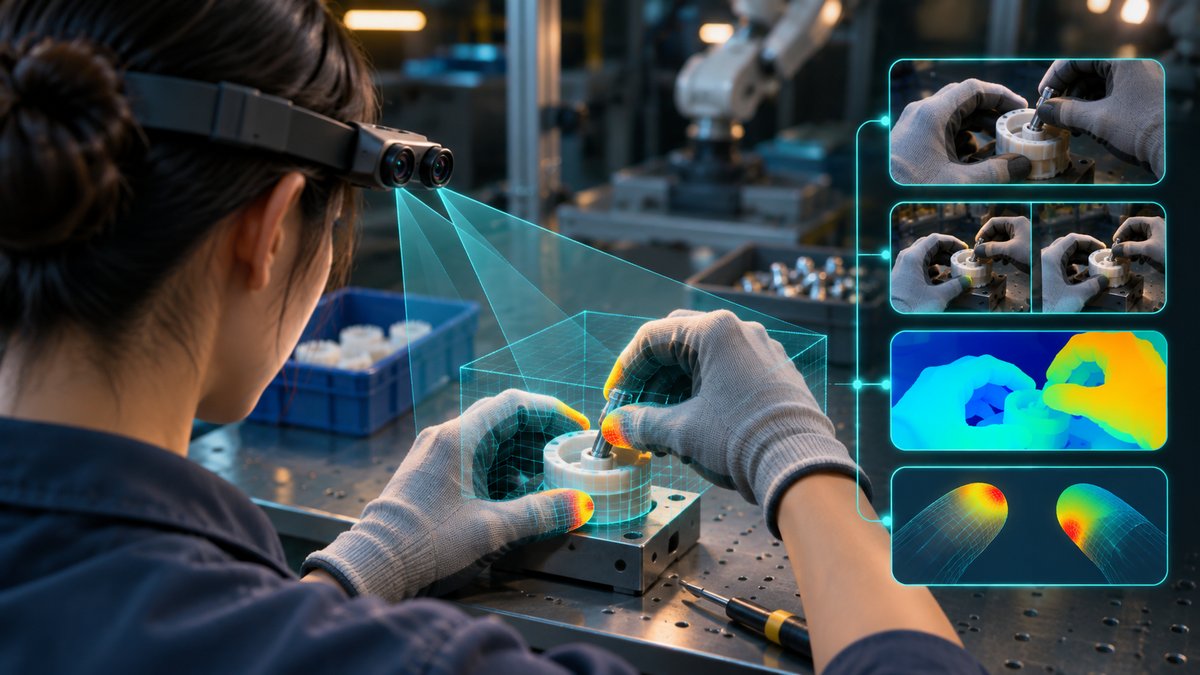
When robotics teams request “first-person training data,” they may be asking for very different things. One team needs a clean head-mounted RGB video of a packaging task; another needs two temporally aligned camera views to estimate depth; a third needs measured distance values; and a manipulation team may need signals that reveal fingertip contact.
These requirements are often described as Monocular Ego, Stereo Ego, Depth Ego and Tactile Ego. Understanding their differences is essential before specifying sensors, pricing recorded hours or accepting a dataset.
The key distinction: these are not four steps on a quality ladder. They describe overlapping observation modalities. A single collection session may legitimately contain all four.
1. Monocular Ego: the first-person visual record
Monocular egocentric video records the world from one principal first-person camera. “Ego” describes the viewpoint, not a particular file format or camera brand. Typical tasks include preparing food, picking and packing objects, sorting components, assembling furniture or handling tools.
Monocular RGB can support action recognition, temporal segmentation, hand–object interaction analysis, video-language alignment and aspects of imitation learning. It often provides a practical starting point when detailed metric geometry is not required.
But a monocular video does not directly provide true physical distance or contact force. A learned model may estimate depth or 3D pose from one view, yet those estimates should not be sold as measured ground-truth geometry. If the brief specifies absolute distance in meters or calibrated force, RGB alone is insufficient.
Buyer checklist: confirm point of view, field of view, resolution, real frame rate, hand visibility, task boundaries, occlusion thresholds, whether sound is needed, and the intended downstream labels.
2. Stereo Ego: two calibrated viewpoints, not just two files
Stereo egocentric capture uses two cameras with overlapping fields of view and a known spatial relationship. Corresponding points appear at different positions in the left and right images; that disparity can be used to estimate scene depth.
The value of Stereo is not merely extra coverage. It is geometry recoverable from a calibrated, synchronized camera pair. Two cameras pointed in opposite directions, or two unsynchronized video tracks without calibration, do not constitute a reliable stereo dataset.
For stereo buyers, the specification should define each camera’s sensor model, resolution, exposure behavior, frame timing, baseline, intrinsics, extrinsics, distortion model, common field of view and calibration-file delivery. Fast hand motion makes temporal misalignment particularly damaging.
The stereo-depth documentation from Luxonis explains disparity-based reconstruction and its dependence on camera calibration and image quality.
Buyer checklist: require two genuinely overlapping streams, separate raw images or video, synchronized acquisition, calibration artifacts and an agreed stereo-quality test. Do not assume a dual-lens device automatically passes.
3. Depth Ego: distance values, not necessarily dual cameras
Depth Ego describes first-person observations that include a depth image or a comparable spatial-depth representation. Each valid depth pixel can represent a measured or inferred distance along the camera’s viewing geometry, often expressed in metric units.
There are several ways to obtain it. A stereo system can compute depth from disparity. Other rigs use time-of-flight or structured-light sensing. A single RGB camera plus a machine-learning model may also produce estimated depth, but estimated relative depth must not be marketed as independently measured metric depth.
The RealSense technical documentation illustrates how stereo depth and tracking coordinate systems require explicit alignment. Real-world depth quality also depends on range, reflectivity, transparency, motion and occlusion.
A “Depth Ego” folder name or RGB thumbnail is not proof of deliverable depth data. Inspect the actual files for a depth stream, encoding, units, invalid-pixel representation, RGB–depth registration and calibration.
Buyer checklist: specify raw depth versus processed or predicted depth, valid measurement range, depth units, coverage/holes, accuracy at target distances, alignment to RGB and how invalid values are represented.
4. Tactile Ego: what happens at the contact interface
Tactile Ego combines first-person or task-centric observations with sensors that record physical contact. Wearable fingertip sensors can capture pressure-related signals, local deformation, magnetic changes or images from visuotactile surfaces. Some systems pair these signals with hand pose, wrist motion, stereo cameras or IMUs.
Tactile signals can help a model distinguish initial contact from slip, changes in grasp stability, or deformation of a soft object. This matters for fastening, cable insertion, opening containers, manipulating flexible goods and many other precision tasks.
However, hand-motion tracking is not a tactile measurement. A glove with joint angles or 21 hand keypoints may be useful, but it does not by itself record fingertip pressure. Equally, a grayscale tactile image does not automatically contain calibrated newton-force values or six-axis wrench estimates.
Buyer checklist: document sensor family, channel mapping, sampling frequency, raw versus calibrated outputs, force/pressure units if applicable, dynamic range, sensor placement, calibration metadata, and actual temporal alignment with visual recordings.
At a glance: which data product answers which question?
| Data type | Core deliverable | Strength | Common overclaim |
|---|---|---|---|
| Monocular Ego | One first-person RGB stream | Actions and context | “True metric 3D from video alone” |
| Stereo Ego | Calibrated synchronized left/right streams | Disparity and spatial structure | “Any two cameras are stereo” |
| Depth Ego | Depth map plus units and registration metadata | Distance and geometry | “Depth is guaranteed because the device has stereo” |
| Tactile Ego | Contact-related sensor channels and metadata | Contact and manipulation dynamics | “Hand keypoints are tactile force” |
How to choose a combination for your robotics task
Begin with the question the training model must answer, not the largest number of available sensors.
- Understanding task sequences: a clear Monocular Ego collection may suffice if timing, object visibility and labels are good.
- Learning spatial manipulation from human demonstrations: Stereo Ego with trustworthy calibration and, when needed, hand pose or IMU may provide stronger geometric cues.
- Training models that consume explicit 3D geometry: request Depth Ego and specify metric accuracy, range and alignment rather than only a depth-capable hardware name.
- Learning grasp stability, slip or delicate contact: consider tactile signals, preferably aligned to the visual streams and tied to well-defined contact events.
- Advanced multimodal tasks: combine modalities only where the model architecture and acceptance plan can actually use them; otherwise complexity and rejection risk may increase without a proportional gain.
The procurement details that matter more than the label
A useful request for proposal should include six things: (1) target tasks and operating environment; (2) required sensor streams and calibration; (3) timestamp provenance and synchronization evidence; (4) output schema, raw assets and format-conversion expectations; (5) objectively measurable rejection and rework rules; and (6) permissions and commercial AI-training rights.
For example, LeRobot Dataset v3.0 organizes time-series data in Parquet, visual streams in MP4, and schema/episode metadata in sidecar files. Delivering a folder named “LeRobot” is not enough: the buyer should verify that actual features, timestamps, frames and episode boundaries load correctly.
Timing is especially easy to overstate. Two streams both showing 30 frames per second can still be out of phase; re-created 33.3-millisecond timestamps do not prove hardware-level synchronization. Require direct evidence when the task depends on tight contact timing.
Microtaka’s approach to multimodal data collection
Microtaka works from the buyer’s training objective backward to a project-specific capture specification. Through an APAC operating network, local collection configurations may be assessed for first-person video, stereo, depth, hand motion and tactile signals. No device availability, accuracy or dataset volume should be assumed before the relevant site and pilot configuration are confirmed.
We focus on an end-to-end delivery definition: suitable real-world tasks, qualified field execution, raw and derived data requirements, provenance, quality assurance, accepted-hour rules and commercial rights. The result should be a dataset the buyer can test—not merely a sensor demonstration.
Which modality does your robot actually need?
Share the task, training objective, preferred schema, required streams and proposed acceptance criteria. Microtaka can assess project-specific real-world collection options across APAC.
Technical references
- Luxonis — Configuring Stereo Depth
- RealSense — Tracking and Depth Cameras Alignment
- Hugging Face — LeRobot Dataset v3.0
- Ego4D — Egocentric Data Documentation
Independent technical and procurement analysis by Microtaka. Examples are illustrative, not representations of verified Microtaka sensor inventory or completed customer datasets. Illustrations are AI-generated concepts. Equipment and format requirements must be validated against each buyer’s written specification.