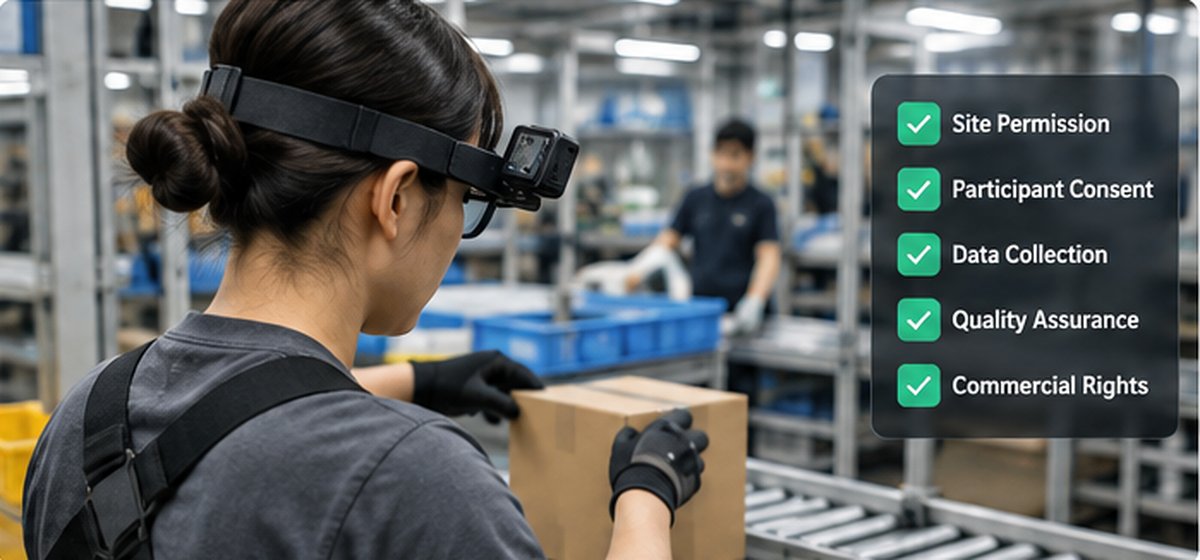
A robotics data project can fail even when the camera works, the files open and the recording looks convincing. The operator may move outside the field of view. The required action may not appear often enough. Sensor timestamps may be reconstructed rather than acquired. The site may lack a workable release for commercial model training. Or the supplier may count recorded hours while the buyer pays only for accepted hours.
These problems are particularly relevant when an overseas robotics team commissions collection in real factories, kitchens, warehouses or other workplaces across Asia-Pacific.
The central procurement question is not “How many cameras or workers can you deploy?” It is “What amount of usable, legally deliverable, buyer-accepted data can you produce against a written specification?”
1. Start with the robot task, not the country or device list
A useful collection brief specifies the behavior the model should learn. “Warehouse data” is too broad. “First-person footage of workers closing cartons and applying labels, with both hands continuously visible and clearly bounded task starts/ends” is testable.
Define representative objects, tools, surface materials, worker motions, environments, shift variations and failure cases. Distinguish required tasks from optional diversity. Where contact-rich manipulation is important, explicitly state whether the buyer needs hand pose, stereo geometry, depth, IMU or tactile signals.
Otherwise a local execution team may capture hundreds of irrelevant clips that are technically valid video but do not address the training objective.
2. Qualify real sites and legitimate participants
A field partner’s network size is not the same as deployable production capacity. Before a pilot, ask which sites are ready now, which are only prospects, how recording will fit the actual workflow, and what happens if workers or managers withdraw consent.
A site readiness record should name the authorized activity categories, available working windows, safety restrictions, camera mounting constraints, expected usable recording time and a local point of contact.
Consent and recording permissions should address the actual uses—not merely “being filmed.” Depending on local law and the site, commercial AI/robotics model training, onward delivery, processing and transfer across borders may require explicit contractual or other lawful bases. Obtain jurisdiction-specific legal advice where necessary.
For perspective, the Ego4D project documents consent and de-identification practices alongside its large-scale first-person dataset. Its licenses also illustrate why access to research video should never be confused with blanket commercial redistribution rights.
3. Prove the proposed sensor configuration before counting hours
Use a paid or otherwise authorized qualification session to confirm the *actual* equipment that will run at the intended site, not just the manufacturer’s marketing sheet. A head-mounted RGB camera is not automatically stereo; two video streams are not automatically calibrated; a tactile glove is not necessarily a calibrated force sensor.
A field-readiness check may include:
- Camera model, mounting angle, field of view, nominal and measured FPS, exposure and minimum usable lighting.
- For stereo or depth: camera intrinsics/extrinsics, baseline, overlapping field of view, depth units and invalid-pixel conventions.
- For hand tracking or tactile: sensor attachment, channel mapping, sampling rate, calibration state and missing-sample handling.
- Across devices: native timestamps, clock or hardware-trigger design, offset, jitter, drift and resampling history where required.
- Power, battery changes, storage capacity, file naming and local recovery procedures.
Even perfectly regular 30 FPS timestamps only demonstrate a 33.3 ms exported interval; they are not evidence of sub-millisecond hardware alignment. Where precise contact timing matters, acceptance must depend on measurements from the pilot configuration.
4. Distinguish four different measures of “hours”
Commercial negotiations become unsafe when “hours” is left undefined.
| Metric | Meaning | Common procurement issue |
|---|---|---|
| Scheduled hours | Collector time booked at the site | May include setup, downtime and breaks |
| Recorded hours | Total duration written to files | Can include idle or technically unusable material |
| Internally approved hours | Material passing the supplier’s QA | Supplier criteria may differ from the buyer’s |
| Buyer-accepted hours | Material accepted under the contract’s definition | Only a written buyer-side gate establishes the payable outcome |
Illustrative unit-economics example: if a project needs 50 buyer-accepted hours and only 80% of recorded time is ultimately accepted, the field plan must budget at least 62.5 recorded hours before contingency. The 80% rate is a hypothetical planning assumption, not a market benchmark or an actual Microtaka supplier result.
The practical point: quote and plan against the exact acceptance unit, including how rejection, reshoot and partial acceptance are handled.
5. Build QA around observable events, not just file integrity
A video decoder can report that every frame exists, while the task is still unusable. Good QA should separate several layers:
- Structural: required assets exist, names and schema are correct, files decode, frame counts and episode boundaries agree.
- Signal: required modalities are present, timestamps are sane, calibration artifacts are usable, missing samples are identified.
- Task: target action actually occurred, hands/objects remain sufficiently visible, start/end points and the outcome are observable.
- Diversity: task mix, objects, operators and sites meet the contracted distribution rather than repeating one easy maneuver.
- Compliance: consent, venue rights, permitted uses, de-identification decisions and access restrictions are documented.
Random spot checks are useful, but a risk-based approach should sample across sites, operators, shifts and tasks—not just the cleanest demonstration clips. Final buyer evaluation needs an agreed rejection code list and an appeal/rework workflow.
6. Deliver files a training team can actually load
Delivering a ZIP full of MP4 files is not a complete training-data specification. At minimum, buyers should be able to identify each episode, its task, duration, modality channels, data types and provenance record.
A robust package may include raw recordings, exported/normalized files, sensor timestamps, calibration and synchronization reports, session manifests, QA metrics, task taxonomies, de-identification actions and file checksums. File-level hashes can help verify that the delivered asset matches the reviewed asset.
LeRobot Dataset v3.0 is one possible training-data organization: it combines Parquet time-series records, MP4 visual streams and structured metadata. Other buyers may require ROS bags, MCAP, RLDS or a proprietary schema. The format should follow the model team’s ingestion requirements, with explicit test fixtures.
Dataset validation should attempt to load actual episodes, compare time indexes to the corresponding video frames and inspect whether each named feature contains the promised signals. Metadata labels alone do not establish compatibility.
7. Align the field subcontract with the buyer’s acceptance contract
When a regional operator coordinates multiple field partners, contract alignment is as important as sensor alignment.
Consider a supplier contract that declares data automatically accepted after ten business days, while the downstream buyer has a longer review period. The prime contractor could become obligated to pay upstream before the buyer has accepted or paid. This mismatch can erase margins from an otherwise attractive project.
Before collection begins, align the chain on the written statement of work, accepted-hour definition, rejection reasons, cure period, ownership and license effective date, consent evidence, liability boundaries, security requirements and approved payment milestones.
Do not assume that a supplier’s general permission to “use recordings for AI” automatically includes assignment, overseas delivery, onward sublicense, or the specific customer’s commercial training use.
A compact buyer-side preflight checklist
Before authorizing full production, the project owner should be able to answer yes to every relevant question:
- Are the target tasks, objects and operating conditions clearly specified?
- Are real sites and participants confirmed, not merely listed as potential capacity?
- Are consent, venue permissions and commercial data rights evidenced?
- Is the exact hardware configuration named and demonstrably deployable?
- Are required raw formats, schemas and calibrations available?
- Is cross-sensor timing measured where model performance requires it?
- Have representative sample episodes passed both technical and task QA?
- Are accepted-hour calculations, rejection and reshoot rules written down?
- Can delivered data be independently loaded and its provenance audited?
- Are upstream and downstream acceptance/payment obligations compatible?
Each unresolved item should be treated as a pilot risk, not concealed behind a generic claim of “training-ready.”
Why APAC execution is an operations problem
Commercial workplaces across Asia-Pacific can offer valuable task variety and real physical interactions. But multi-country deployment adds variability in scheduling, labor practices, site permissions, languages, network access, equipment availability and transfer requirements.
Microtaka’s role is to organize collection against buyer-defined acceptance criteria through local execution partners. Depending on the brief, programs may evaluate monocular or stereo egocentric video, depth, IMU, hand tracking and tactile sensing. Specific site, staffing and hardware capabilities are verified per project rather than advertised as a universal ready-to-deploy inventory.
A defensible pilot starts with one auditable collection specification and ends with buyer-accepted, rights-cleared data. Expanding headcount or adding sensors before that loop is validated usually increases risk faster than it creates customer value.
Make acceptance criteria your starting point
Microtaka coordinates project-specific real-world Physical AI data collection across APAC. Share your task brief, modality requirements, preferred delivery schema and acceptance rules to assess feasible local execution.
Further reading
- Hugging Face — LeRobot Dataset v3.0 Documentation
- Ego4D — Dataset, Privacy and Licensing Overview
- RealSense — Tracking, Depth and Spatial Alignment
Microtaka’s independent operational guidance, not a legal opinion or a certification of any site or supplier. Actual rights, privacy duties, cross-border transfer conditions and acceptance standards depend on project-specific contracts and applicable law. Illustration is AI-generated and does not depict a verified partner workplace.